<Back to news
4 May 2026
Part 4 of School Readiness Series: Confident Movement Sparks Curious Minds
Written By Heidi Lopez-Gamez
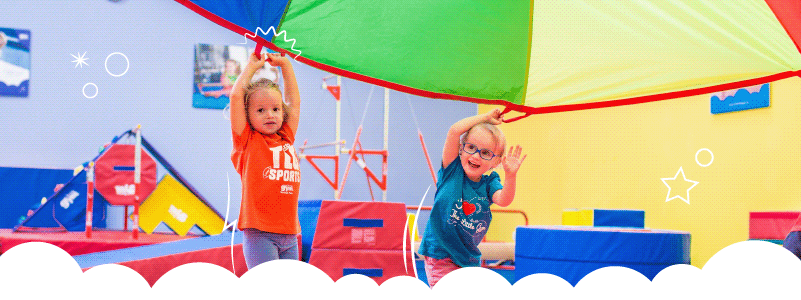
How physical confidence unlocks curiosity, creativity, and a love of learning
You’ve probably seen it happen: your child gives something new a go, takes a wobbly step or a brave little jump, and suddenly lights up when it all comes together. That burst of pride, that“I can do this”moment, is pure joy.
As a Little Gym teacher, I see that moment every day. And what always follows is something just as powerful:
Curiosity.
Once children feel strong and capable in their bodies, they start to explore more boldly. They wonder. They experiment. They ask questions. They try again. Confidence doesn’t just make them braver;it makes them more curious.
Curiosity is one of the strongest predictors of early learning success.
At The Little Gym, movement fuels that spark. Every jump, climb, and swing inspires problem‑solving, creativity, and a love of learning. Through playful, non‑competitive gymnastics, children learn to take safe risks, think creatively, and explore with confidence, building the foundation for curious minds and ready learners.
Strong bodies. Ready minds. Confident kids who are prepared for school and beyond.
Why curiosity matters for school readiness
Curiosity is the engine behind early learning. Research from the American Academy of Paediatrics shows that children who feel confident exploring their environment show stronger problem‑solving skills, greater persistence, and higher engagement in learning tasks (AAP, 2018).
In the classroom, curiosity looks like:
- Choosing to explore a new activity
- Asking “why?” and “how?”
- Persisting when something feels tricky
- Approaching learning with excitement rather than hesitation
But curiosity doesn’t grow in stillness.
It grows in movement, in the moments when children feel safe, supported, and capable.
Exploration within safe boundaries
One of the things I love most about our gym is how children can explore freely while still feeling safe.
That balance and freedom within structure helps them learn to:
- Test ideas
- Make decisions
- Try new approaches
- Navigate challenges independently
The NHS highlights that this kind of exploratory play supports early cognitive development and helps children become active, engaged learners (NHS, Early Years Development).
When children feel safe to explore, their curiosity naturally expands.
Problem‑solving through movement challenges
Movement challenges are where curiosity and thinking come together. When a child is figuring out how to climb over a block, balance along a beam, or navigate an obstacle course, they’re not just moving, they’re problem‑solving.
They’re practising:
- Trial and error
- Cause and effect
- Sequencing
- Spatial reasoning
- Persistence
These are the same skills they’ll use in early maths, science, and everyday classroom tasks. And because the challenges are playful, children stay motivated. They learn that problem‑solving isn’t about perfection, but about exploration.
Creative thinking during guided play
Guided play is where imagination takes off. I might set up an activity, but the magic happens when children decide how to use it.
I’ve seen a beam become a “bridge,” a mat become a “mountain,” and a set of blocks turn into a rocket ship.
Creative play supports:
- Flexible thinking
- Early language development
- Emotional expression
- Cognitive growth
Research shows that creativity and executive function are closely linked (Diamond, 2013). When children are encouraged to think creatively, they become more confident learners who approach new experiences with curiosity rather than fear.
The Little Gym approach: space to discover
Our curriculum encourages:
- Exploration within safe boundaries
- Problem‑solving through movement challenges
- Creative thinking during guided play
But the heart of what we do is simple:
We give children space to discover what they can do.
And that discovery is where curiosity begins.
The outcome: curious, engaged, willing learners
When children feel physically confident and emotionally supported, they become:
- Curious
- Engaged
- Willing to try
- Ready to explore
- Eager to learn
These qualities matter just as much as early academics. A curious child is a motivated child who approaches learning with excitement rather than pressure.
And that’s what creates a love of learning.
Coming next
In Part 5, we’ll explore how sensory development helps children feel calm, focused, and organised — and how these systems bring together the foundations of school readiness.
If you’d like to see how confidence and curiosity grow through movement, we’d love to welcome you into the gym. Come watch your child explore, try, and discover what they can do. It’s one of the most joyful parts of childhood.
References
American Academy of Paediatrics. (2018).The Importance of Play in Promoting Healthy Child Development and Maintaining Strong Parent-Child Bonds.
NHS. (n.d.).Early Years Development: Cognitive Development & Learning Behaviours.
Diamond, A. (2013).Executive Functions.Annual Review of Psychology, 64, 135–168.